BEING MINDFUL IN CHURCH
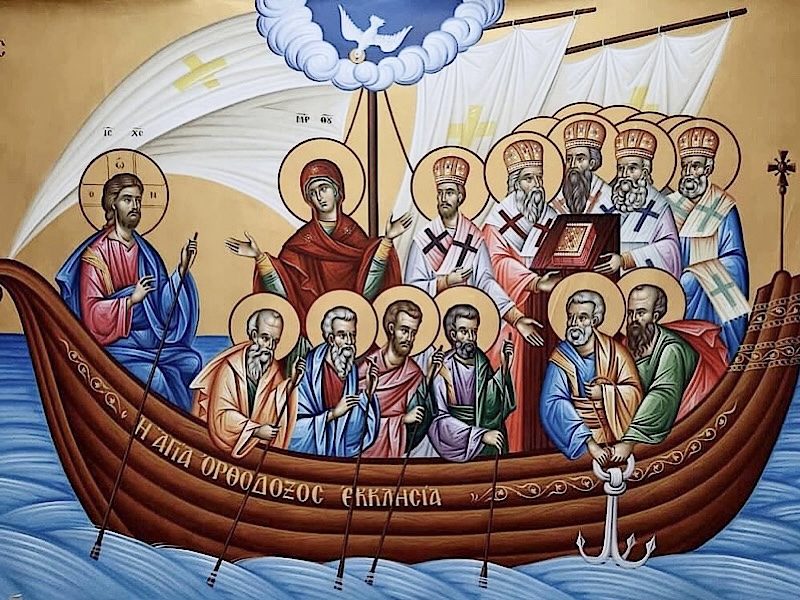
The Church is the Body of Christ on earth, the gathering of the people of God who assemble together to worship. The Church, a living organism, a treasury, a storehouse of centuries of wisdom in humanity’s efforts to relate to God and all people. When we come to the church and its services we are entering the Kingdom of God on earth, His habitation, and we choose to honor this sacred place by our attentiveness to what is proper and ordered.
This guide is meant for personal reflection only, not as a means of judging others. Keep in mind that there are different traditions even among the Orthodox faithful. We come to church to pray and worship God above all else, and that should be our only focus.
THE DIVINE LITURGY
The Orthodox Divine Liturgy begins when the priest intones, “Blessed is the Kingdom of the Father, and the Son, and the Holy Spirit.” It is appropriate to arrive early enough to receive this blessing. If an occasional problem arises and you arrive late, enter the church reverently and quietly and in a manner that does not distract others.
Preparations by Baptized Orthodox Christians to receive Holy Communion (Eucharist) include participating in the prescribed fast periods of the Church, including fasting from midnight on Saturday until after Holy Communion on Sunday, the reading of the communion prayers, and also may include Confession.
To receive Holy Communion the faithful should come forth from the side aisles and exit via the center aisle to return to their pew.
The faithful are to approach reverently, avoiding actions that might come into contact with the chalice.
When receiving Communion, the faithful should hold the cloth under our chin, in order to catch any that may fall. After receiving, lightly touch the cloth to your lips to blot up any remaining Communion.
Sunday Church School teachers and students are permitted to depart early from the Divine Liturgy. They will do so following the Holy Eucharist.
Once the Divine Liturgy has concluded, to receive the Antidoron (blessed bread), the faithful come forward from the side aisles and exit via the center aisle.
When receiving Communion, the faithful should hold the cloth under thier chin, in order to catch any that may fall. After receiving, lightly touch the cloth to your lips to blot up any remaining Communion.
FACING EAST
Since the time of the Apostles, Christians have faced eastward in worship and prayer.
"For as the lightning comes from the east and shines as far as the west, so will be the coming of the Son of Man" (Matthew 24:27).
When we orient our bodies is this direction, we proclaim our faith in Christ’s second coming.
Therefore Orthodox Christians face east during worship. In the home, the icon corner is also normally located on an eastern wall.
ENTERING THE CHURCH
There are times in which you must stay in the narthex, the foyer or anteroom, of the church before entering these include:
- When the priest is facing the congregation i.e, censing the altar, icons, and congregation
- When the Small or Great Entrance is taking place
- When the Epistle or Gospel is being read, or the priest is giving the homily.
If you are unsure when is the best time to enter the church, ask one of the ushers for guidance.
CANDLES
We light candles as an expression of our belief that Jesus Christ is the “Light of the world.”
“I am the light of the world; he who follows me will not walk in darkness, but will have the light of life.” (John 8:12)
When an Orthodox Christian enters the narthex of the church, they make the sign of the Cross, light a candle, offer prayers, and venerate the icons. A candle may be lit for one’s personal needs, needs of family members or friends, or in memory of a departed loved one.
The seven day candles may be lit for the same reasons. Seven day candles are placed in the special stands located on each side of the church.
It is customary to make a donation for each candle.
VENERATING ICONS
It is the practice of the Orthodox Church to venerate (reverence, deep respect, honor) not worship icons. Veneration is showing delight for what God has done, a way to show great respect for that which is holy.
The Orthodox Church calls for the elaborate use of symbolism and iconography in the interior decoration of the church building. Icons are not simply portraits representing people, but graphic presentations of spiritual truths that are visual aids to contemplation and prayer.
The acceptable way to do this is, make the sign of the cross, and kiss either the hands or feet, the scroll, the Gospel book, or the hand cross the depicted saint is holding in the icon. Please wipe off lip products (lip stick, chapstick, etc.) when venerating icons, the gospel book, or cross.
SIGN OF THE CROSS
We make the sign of the Cross as a public profession of our Orthodox Christian faith. The first two fingers and thumb of the right hand come together, symbolizing the Holy Trinity. The two remaining fingers pressed into the palm symbolize the Humanity and Divinity of Jesus Christ. We cross ourselves from the head to the breast and from shoulder to shoulder, right to left respectively.
Therefore, in our right hand, we hold the two major doctrines of our Orthodox Christian Church each time we make the sign of the Cross.
You can and should make the sign of the cross any time you wish for personal petitions. There are certain times during the Liturgy when we all make the sign of the cross.
In church, make the sign of the cross:
- When you light a candle
- When you venerate the icons
- When you hear “Father, Son and Holy Spirit,” “Holy God, Holy Mighty, Holy Immortal, have mercy on us,” “the Theotokos”
- At the end of the Gospel reading
- During the Creed when we say Articles 8 and 9: “And in the Holy Spirit, the Lord, the Giver of Life…” and “In one holy, catholic, and apostolic Church”
- Whenever you cross in front of the Alter
- If you are an Altar Boy when you enter the Holy Altar and when you pass behind the Altar.
It is not necessary to cross oneself when the priest is giving a blessing or censing the congregation. Instead, one should bow to receive the blessing.
We make the sign of the Cross before we eat, sleep, drive, pass by, enter or leave the church, travel or begin any major endeavor, etc, acknowledging our desire to include God in these activities.
BOWING
Orthodox Christians bow when the Theotokos and Christ are petitioned. They also bow to the priest at his blessing, when he asks forgiveness before the Great Entrance and again before Holy Communion. It is traditional for the Orthodox faithful to bow and cross themselves when they enter and leave the church and when they pray before the icons.
SITTING and/or STANDING
There are certain times during the Divine Liturgy, if you are sitting in a pew, when you should stand and also avoid moving about or entering the church.
These times are:
- During the Doxology, the beginning of Liturgy and the priest giving the blessing.
- During the Small Entrance
- When the priest censes the Altar, icons, and congregation throughout the Divine Liturgy
- During the reading of the Gospel
- During the Great Entrance
- During the recitation of the Creed and Lord’s Prayer
- During the Consecration of the Holy Gifts
- During Holy Communion
- At the final Blessing
- During any special services such as Memorials or the Blessing of the Five Loaves, etc.
Whenever a hierarch is visiting the parish, out of respect, follow his example and stand and sit when he does.
It is the custom of some Orthodox Christians to stand throughout the Divine Liturgy as well as during other services. If you choose to stand in a church that has pews, please do so near the back or sides so that the view of the altar is not blocked for those who are seated.
KNEELING
In some Orthodox traditions there are times when kneeling is a pious practice in the Liturgy, the most notable being at the Consecration of the Holy Gifts. Kneeling is an expression of prayer that has two characteristics: penance and/or prayer (Please remember, kneeling is prohibited during the Paschal season, from Pascha to Pentecost, in honor of the Resurrection). Following the Divine Liturgy of the Pentecost Sunday, the Service of Kneeling is prayed, the congregation resumes kneeling as an expression of prayer.
TOUCHING THE PRIEST VESTMENTS
One of the pious practices of the Church is to reach out and touch the Priest’s vestments as he passes by in the Great Entrance. This practice is in imitation of the woman who was healed by touching the hem of Christ’s robe (see Matt. 9:20-22). When touching the Priest’s vestments, one should not step into the procession, pull on or tug at the vestments, or push anyone away.
CHILDREN IN CHURCH
Christ said, “Let the little children come to Me, and do not forbid them; for such is the kingdom of heaven” (Matthew 19:14).
We rejoice at the sounds of children, because they are the future of the Church! While children may fuss in church at first, show them how much you love being in church, and they will come to feel the same way as they live and grow in the Faith.
Please be mindful of fellow worshippers; if a child becomes too disruptive, step out into the narthex or go into the “Cry Room” as quietly as possible. Once the child has calmed down, come back into the church; this is where they belong.
As Orthodox Christians, there is no greater gift that we can give our children than the experience of the Faith and of Christ.
CHURCH ATTIRE
Coming to church involves preparation of oneself for a serious and sacred encounter and is not a casual experience. We dress accordingly out of love and respect for our Lord who we meet in a mystical manner in church each time we celebrate the Divine Liturgy.
We should dress respectfully and modestly for the occasion as you are able. Not in a flashy way that would call attention to ourself, but if all you have available are shorts and a t-shirt, join us as you are.
Parishioners typically dress according to the business casual standard.
The word to keep in mind is respect – respect for God, respect for oneself, and respect for those in whom we share in Orthodox Christian fellowship. Equally as important as respect is – modesty.
MORE TO CONSIDER WHEN ATTENDING DIVINE SERVICES
- Please remember to turn off your cell phone and refrain from texting during the celebration of the Divine services. If there is an emergency, please leave quietly and try not to distract others.
- Avoid reserving seats for family or friends that may come late to the Divine services. Make room for all that come to attend, and in particular, visitors, so that they feel welcomed.
- When venerating an icon, the cross, when receiving Holy Communion, or kissing the hand of the Clergy, please wipe off lip products (lip stick, chapstick, etc.).
- Chewing gum in church is never permitted.
- Refrain from socializing during the Divine services. When attending the Divine services, you must be attentive, not casual. The Divine services are not meant to “entertain”, but to call the people of God to be attentive and worship Him. In the Divine services, our focus must be on God and in bringing ourselves closer to Him.
- The respectful protocol is to leave the church only after the final blessing of the Divine services. If you do need to leave early, do so in a manner that does not distract others.
GREETING OR SPEAKING WITH THE CLERGY
We do not shake a bishop’s or priest’s hand; we kiss it with reverence and ask for a blessing. The proper way to do this is to approach the hierarch or priest with right hand over left, palms facing up, and then bow while saying, “Master, bless” to the hierarch, or “Father, bless” to the priest. If either places his hand in yours while blessing you, this is an appropriate time to kiss his hand. We kiss his hand because we are honoring Christ, whom he represents
When speaking with the Clergy the following terms are proper:
- To the Patriarch of Constantinople: “Your All-Holiness”;
- To all other Patriarchs: “Your Beatitude”;
- To the Archbishop/Metropolitan: “Your Eminence”;
- To the Bishop: “Your Grace”;
- To a Priest: “Father”;
- To a Deacon: “Deacon”.
Above all:
“In all things, give glory to God.”
The above guide contains excerpts from "A Guide to Church Etiquette: How to Show Proper Respect and Reverence in Church". Visit Ancient Faith Store to obtain a PDF version of that guide!
Weekly Services:
When scheduledCalendar
Sunday:
Orthros - 9:00 a.m.Divine Liturgy - 10:00 a.m.
Address:
674 42nd streetSouth Ogden Utah, 84403
Directions